New Fuel Economy Ratings on EPA Window Labels Show Need for Improvement

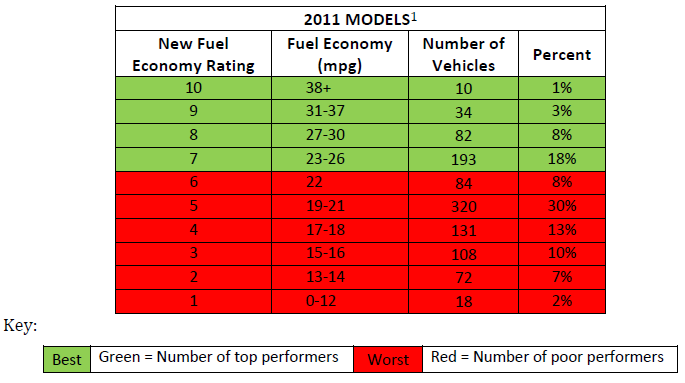
Washington, D.C. – The good news: The new fuel economy labels will empower consumers looking for more fuel efficient vehicles. The bad news: Applying the ratings to the 2011 models, shows the majority of vehicles get a rating of 6 or less. “If (like school) you consider anything below a 60 to be a failing grade, then 70% of the 2011 models would fail under the new fuel economy labeling requirement,” said Jack Gillis, CFA’s Director of Public Affairs and author of The Car Book.
The Consumer Federation of America has applied the sample rating system, developed by the Department of Transportation (DOT) and the Environmental Protection Agency (EPA), to the current model year vehicles and the results show a great need for improvement. “Right now, only 1% of the 2011 models available get a perfect 10 in fuel economy and greenhouse gas emissions,” said Gillis. The following table shows how the 2011 models score according to the sample ratings.
As the new fuel economy labels begin appearing on 2012 models, consumers will begin to be able to more readily compare vehicles. “Not only will these ratings empower consumers, enabling them to ‘vote’ with their hard-earned dollars for better performing vehicles, but even those consumers who don’t use them will benefit from manufacturers scrambling to avoid the bottom of the list,” said Gillis.
Right now, nearly 20% of the 2011 models are at the bottom of the list, getting 1’s, 2’s, and 3’s. Historically, manufacturers do not like being at the bottom of any lists, so this alone, will be a strong motivator to improve.
“One of the issues that has surfaced in our surveys is that consumers want better performing vehicles, but they just are not available,” said Dr. Mark Cooper, CFA Director of Research. “Giving consumers good information addresses part of the problem, but raising fuel economy standards, which is the next item on the agenda of the DOT and EPA, is critical to lowering gasoline consumption and reducing oil imports,” added Cooper.
Consumers Have Many Choices in the Same Size Class
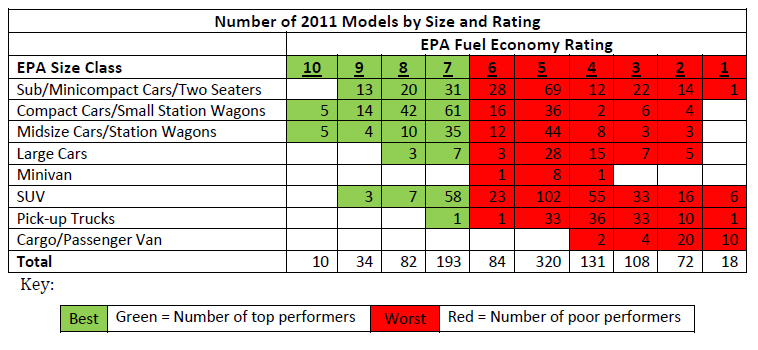
What is particularly remarkable about applying the new ratings to today’s vehicles is that there are wide variations in performance within the same size class. The table below shows that you can buy an SUV that has a rating of 9 or with a rating of 1. If you’re looking at a compact car for fuel efficiency, beware some get 9s and 10s (19) and some get 2s and 3s (10). These new ratings show that smart shoppers can make significant improvements in their fuel economy even within the same size class. This is important because most consumers are not deciding between a mid-size SUV and a subcompact car. “Just because family needs may dictate the type of vehicle consumers need, it doesn’t mean that buyers are relegated to certain levels of fuel efficiency,” said Gillis.
The table below shows the range of rankings available in each size class.